Finding the right roaster for a private label coffee brand means balancing capacity, control, and consistency. Below is a concise comparison table of five home-to-light-commercial roasters suited for private label production and small-batch testing.
| Roaster | Best For | Key Feature |
|---|---|---|
| Fresh Roast SR540 | Small-batch precision | Digital temp display, convection fan |
| JIAWANSHUN 1.1lb Electric | High capacity home/small shop | 0–240℃ thermostat, 1200W |
| 1Pound Automatic Roaster | Flexible roasting modes | Automatic/manual modes, smoke filter |
| DIYAREA 800g Electric | Multi-purpose roasting | Timer, non-stick, multi-ingredient |
| Kllkmmws 500g/1.1lb | Large capacity & even heat | Honeycomb pot, adjustable temp |
Fresh Roast SR540 Automatic Coffee Bean Roaster

The Fresh Roast SR540 Targets Users Who Want precision and repeatability for small-batch private labeling. The unit features a precise real-time temperature display and nine power settings to fine-tune profiles. Its convection fan control and speed roast motion help deliver even roasts across the batch.
Capacity and performance: The SR540 handles up to roughly 120 grams (4 scoops), suitable for recipe development and sampling. The manufacturer highlights fast roast cycles that can roast 7–14 cups in under 10 minutes, which helps iterate roast profiles quickly without long downtime.
Considerations: This is a small-batch machine ideal for recipe development and sample production rather than high-volume retail. The SR540 emphasizes freshness and control, useful for dialing flavor for private label offerings.
JIAWANSHUN Electric Coffee Bean Roaster 1.1lb Capacity

This JIAWANSHUN roaster offers a large 1.1 lb (800g recommended) capacity with a 0–240℃ adjustable thermostat and a 1200W heater. The built-in stirring rod and non-stick chassis aim to provide even roasts and easier cleaning—advantages when producing multiple sample batches.
Features relevant to private label: The unit supports a range of roast levels (light to dark) through precise temperature control. The higher capacity compared to tabletop speed roasters lets you produce more labeled product per roast cycle, useful if you need small production runs.
Considerations: For consistent branding, verify batch-to-batch repeatability and cooling efficiency. The manufacturer recommends 300–500g as an optimal range for uniform results despite the larger max capacity.
1Pound Electric Roaster With Smoke Filter And Chaff Collector

This precision coffee roaster blends automatic, assisted, and manual modes, which is useful for varying operator skill levels when building private label roasts. It includes an environmentally friendly ventilation system with a smoke filter and vent pipe to manage indoor ventilation during light roasting.
Production suitability: The 1 lb capacity and multiple program modes accommodate both experimentation and consistent small-batch runs. The presence of a chaff collector reduces maintenance and improves airflow consistency.
Considerations: The ventilation feature may be important for complying with local smoke/venting concerns if roasting indoors. It’s positioned for home to light commercial use, not heavy industrial output.
DIYAREA 800g Electric Coffee Roaster Machine

The DIYAREA roaster is a versatile option with an 800g capacity and timer plus non-stick pot. It supports roasting coffee beans along with nuts and grains, making it useful for specialty private label blends or sample variations where multiple ingredients are tested.
Operational notes: The manufacturer recommends a practical batch range of 300–500g for best results. The unit’s even mixing and efficient cooling features aim to reduce post-roast variability, a key factor for label consistency.
Considerations: Multi-purpose use is helpful for experimentation but verify that the machine’s thermal characteristics match your desired roast profile before scaling up private label runs.
Kllkmmws Coffee Roaster With Honeycomb Pot Bottom
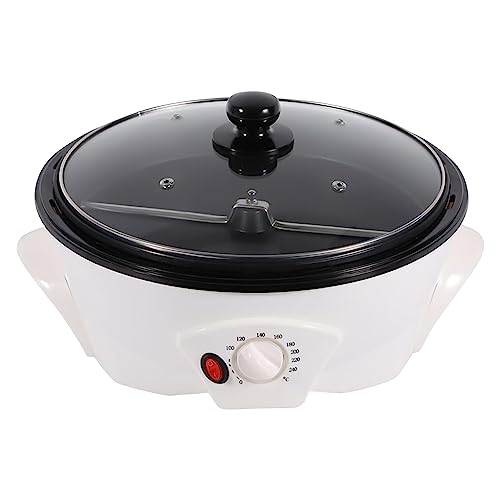
The Kllkmmws roaster emphasizes even heating via a honeycomb pot bottom and offers a capacity up to 1.1 lbs. Its adjustable temperature control (32–464°F) targets better thermal management across different bean types.
Private label relevance: The honeycomb design supports uniform heat transfer, which is valuable for minimizing roast variability across batches. The large capacity and temperature range allow flexibility for both light and dark roast profiles.
Considerations: Confirm recommended batch sizes and cooling methods for consistent flavor extraction. The unit’s large capacity makes it suitable for small production runs or scaling tests.
Buying Guide For Private Label Coffee Roasters
Choosing a roaster for private label production involves balancing capacity, control, repeatability, and compliance. Below are key considerations and comparative perspectives.
Capacity And Throughput
- Small-batch development: Machines like the Fresh Roast SR540 are ideal for recipe development and sampling due to quick cycles and tight control.
- Small production runs: Models with 500–1,100g capacity (JIAWANSHUN, Kllkmmws, DIYAREA) allow you to produce multiple labeled bags per roast.
Roast Control And Repeatability
- Digital temperature and presets: Offer consistent profiles and easier scaling. Look for real-time readouts and adjustable heat curves.
- Manual vs automatic modes: Manual modes are good for experimentation; automatic presets help with consistent production when scaling.
Heat Source, Design, And Evenness
- Convection vs conduction: Convection systems (Fresh Roast) can deliver even roasts quickly. Honeycomb bottoms or stirring rods improve heat distribution.
- Chaff management: Chaff collectors and filters reduce smoke and buildup, improving consistency and maintenance.
Ventilation, Safety, And Environment
- Smoke filters and vents: Vital if roasting indoors; reduces odor and meets local ventilation expectations (seen in the 1Pound model).
- Heat and electrical specs: Ensure unit power matches your workspace wiring and safety regulations.
Cleaning, Maintenance, And Usability
- Non-stick interiors and easy-access chaff bins simplify turnaround between batches.
- Operator skill: Consider whether staff will rely on presets or require manual control for nuanced profiles.
Scaling And Brand Consistency
- Profile transferability: Choose a machine whose roast parameters can be documented and replicated across units when you scale.
- Batch size planning: Test recipes at the machine’s recommended optimal batch size (often smaller than max capacity) to minimize variance when increasing batch counts.
Budget And Use Case Tradeoffs
- Development-focused: Prioritize control and quick cycles over capacity.
- Light production: Favor larger capacity with reliable repeatability and appropriate ventilation.
When selecting a roaster for a private label venture, weigh immediate needs for recipe development against anticipated production volumes. Test roast profiles on the chosen machine at the recommended batch size to ensure product consistency before finalizing packaging and label runs.