Home coffee roasting unlocks fresher, more flavorful brews by converting green beans to roasted beans on your schedule. Below is a concise comparison table of five top automatic roasters chosen for capacity, modes, and smoke control to help you decide quickly.
| Product | Capacity | Modes / Features | Best For |
|---|---|---|---|
| Fresh Roast SR540 | ~120 g (4 scoops) | Variable heat, fan control, digital display | Small-batch precision |
| NIASIA 500g Automatic Roaster | Up To 500 g (recommended 350–400 g) | 9 profiles, smoke filter + vent pipes | Higher-capacity home batches |
| WQV 500g Coffee Roaster | Up To 500 g (recommended 350–400 g) | 3 programs, 9 profiles, built-in chaff collector | Versatile profiles for beginners & pros |
| JIAWANSHUN 1.1lb Roaster | Best 300–500 g (800 g max) | Adjustable temp 100–240℃, timer, glass cover | Visual monitoring & larger batches |
| MAGO MAGA Smart Roaster | 300 g | Digital display, auto/manual, ultra-low smoke | Smart control and low-smoke operation |
Fresh Roast SR540 Automatic Coffee Bean Roaster

The Fresh Roast SR540 is focused on small-batch precision. It supports up to 4 scoops (~120 grams wet processed) and promises rapid, even roasting through a speed roast fluid motion system. A digital status display provides real-time temperature, while nine heat levels and convection fan control let users tailor airflow and heat for different roast profiles.
Designed for both novices and experienced roasters, the SR540 emphasizes freshness—green beans retain flavor much longer than pre-roasted beans. The unit is compact and suited for users seeking fast roasts under 10 minutes and fine-tuned control over roast development.
500g Automatic Coffee Roaster Machine With Smoke Filter

This NIASIA model is a larger-capacity home roaster with both automatic and manual modes. It includes nine built-in roasting profiles that cover light, medium, and dark roasts and processing styles such as sun-dried, washed, and honey-processed beans.
The machine’s 500 g drum is stainless steel, with recommended batch sizes of 350–400 g for best results. Two smoke-handling options are provided: a smoke purifier for light roasts and aluminum exhaust pipes for venting smoke outdoors during heavier roasts. The design targets home users who want profile-based automation and adequate smoke control.
500g Coffee Roaster With 3 Roast Programs

The WQV 500g roaster offers three operating modes—Automatic, Assistant, and Manual—paired with nine roasting profiles. Automatic mode handles preheat and the roast process for beginners, while Assistant and Manual modes give more control over timing and temperature.
Capacity is suitable for home enthusiasts and small cafés, with recommended batches of 350–400 g. The unit includes a built-in smoke filter, chaff collector, and is marketed for versatility across skill levels, allowing users to transition from guided to manual roasting as experience grows.
JIAWANSHUN 1.1lb Coffee Roaster With Timer
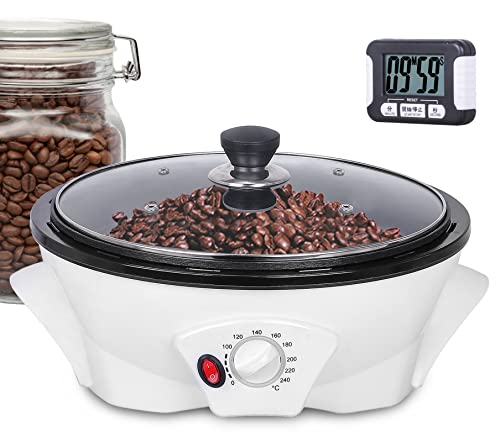
The JIAWANSHUN unit features adjustable temperature control from 100–240℃ and an integrated timer. It has an 800 g maximum design, with the recommended optimal batch size between 300–500 g to maintain even roasting. An automatic mixing rod ensures uniform movement of beans during roast.
A transparent glass cover allows visual monitoring, and a non-stick honeycomb pan bottom simplifies cleanup. This machine suits users who prefer visual inspection and larger batches while retaining control over temperature and timing.
MAGO MAGA Smart Home Coffee Bean Roaster

The MAGO MAGA smart roaster is a 300 g-capacity unit with digital display, timer, and both automatic and manual modes. It emphasizes ultra-low smoke operation and includes chaff collection for cleaner roasts indoors. The interface and automation aim to deliver consistent results for home users.
Described as combining modern tech with classic design, this roaster targets users who want smart controls and lower indoor smoke without compromising the ability to craft personalized roast profiles.
Buying Guide: How To Choose An Automatic Coffee Bean Roaster
Choosing the right roaster depends on batch size, roast control, smoke management, learning curve, and intended use. Below are the primary considerations with comparative perspectives to guide selection.
Capacity And Batch Size
- Small-Batch (≤150 g): Best for single-person households or experimentation—units like the Fresh Roast SR540 excel at quick, precision roasts.
- Medium-Batch (300–500 g): Good balance for families or small groups—NIASIA, WQV, JIAWANSHUN, and MAGO MAGA recommend 300–400 g for consistent results.
- Large Or Commercial (>500 g): Look for models explicitly rated for commercial use with robust motors and industrial ventilation.
Automation Versus Manual Control
- Automatic Modes simplify roasting using preset profiles—ideal for beginners or repeatable results.
- Assisted/Manual Modes let the user intervene on timing and temperature—important for craft roasters exploring development and first/second crack control.
- Choose a roaster that offers both if you plan to progress from beginner to advanced techniques.
Heat Source And Roast Style
- Hot Air/Convection models promote even roasting and faster cycle times, often producing cleaner profiles.
- Direct/Simulated Fire or flame-like designs can yield flavor characteristics closer to traditional drum roasting but may increase smoke and maintenance.
Smoke Management And Venting
- Built-In Smoke Filters help for light roasts and indoor use but may be insufficient for darker profiles.
- External Venting via chimney or exhaust pipes is preferred for regular medium-to-dark roasts to protect indoor air quality.
- Consider local apartment rules and kitchen ventilation before choosing a roaster without effective exhaust.
Ease Of Cleaning And Maintenance
- Look for chaff collectors, removable trays, and accessible interiors to reduce downtime between batches.
- Stainless steel drums and non-stick interiors simplify cleanup and lower contamination risk between different bean origins.
Controls, Display, And Data
- Digital Displays and Timers improve repeatability and allow roasting logs to be followed.
- Manual dial controls can be sufficient but may make precise profiling harder when comparing batches.
Noise, Space, And Kitchen Impact
- Check dimensions and operating noise—smaller machines typically generate less audible noise and require less counter space.
- Ensure you have adequate clearance for exhaust pipes if the model requires external venting.
Use Case Comparisons
- Hobbyists/Experimenters: Favor units with precise heat and fan control and transparency for visual monitoring.
- Regular Home Brewers: Choose mid-capacity roasters with reliable automatic profiles and reasonable smoke filtration.
- Small Cafés: Opt for robust machines rated for repeated use with strong exhaust options and larger drums.
When evaluating models, prioritize capacity matched to your consumption, smoke management compatible with your space, and the level of control you want. Review manufacturer guidance for recommended batch sizes and ventilation to maximize both roast quality and equipment lifespan.