Finding the best coffee grinder for espresso means choosing a grinder that produces a consistent, fine grind, precise dosing, and minimal heat and static. Below is a quick summary of top picks chosen for espresso performance, grind range, and dosing control.
| Image | Model | Brand | Key Strength |
|---|---|---|---|
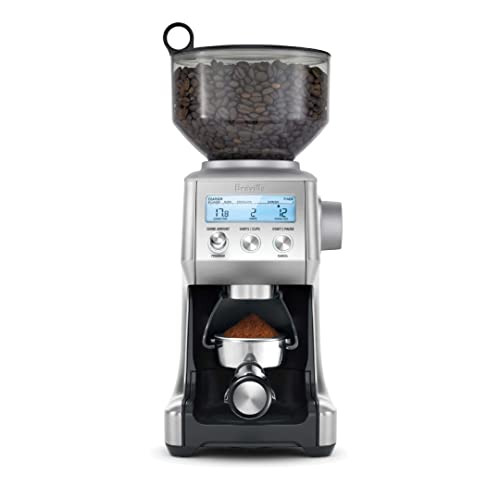 |
Breville Smart Grinder Pro | Breville | 60 settings, Dosing iQ |
 |
OXO Conical Burr Grinder | OXO | One-touch memory, stainless burrs |
 |
Fellow Opus | Fellow | All-purpose with 41 settings |
 |
SHARDOR 51-Setting Grinder | SHARDOR | 51 precision settings, anti-static |
 |
SHARDOR 48-Setting Grinder | SHARDOR | 48 settings, upgraded anti-static |
Breville Smart Grinder Pro
The Breville Smart Grinder Pro uses conical burrs and a broad range of grind settings to support espresso and other brew methods. Its standout feature is 60 unique settings, enabling fine adjustments across a wide dial. The Dosing iQ with 0.2-second increments provides precise digital timing for consistent doses. It can grind directly into a portafilter or container, which helps streamline workflow for home espresso preparation. The combination of high-resolution settings and programmable dosing makes it well-suited for users seeking repeatability and fine control over dose and grind size.
OXO Conical Burr Grinder
The OXO Brew Conical Burr Grinder features stainless steel conical burrs and a simple one-touch start that remembers the last setting. With 15 grind settings plus micro-adjustments, it covers espresso through coarse methods. The conical burrs are designed to deliver uniform grounds and minimize heat. The one-touch convenience and memory function can speed up repeated espresso shots while maintaining consistency in grind size between uses.
Fellow Opus Conical Burr
The Fellow Opus positions itself as an all-purpose grinder with 41+ settings and 40 mm stainless steel conical burrs. Its motor torque and burr design aim for consistent particle distribution across the espresso range. Designed with countertop aesthetics in mind, it balances functionality and appearance. For espresso users who also brew pour-over and drip, Opus offers a wide grind spectrum while focusing on consistency and low retention.
SHARDOR 51-Setting Grinder
This SHARDOR model includes a 40 mm stainless steel conical burr set and 51 precise grind settings. It emphasizes dose control through a precision electronic timer adjustable in 0.1-second increments, and cup quantification from 1 to 12. Anti-static design reduces cling and mess when dosing. The combination of fine step control and a large burr diameter aims to preserve bean oils and produce uniform espresso-grade grounds while supporting repeatable dosing.
SHARDOR 48-Setting Grinder
The SHARDOR Professional model offers 48 grind settings, an LCD touchscreen, and a precision electronic timer adjustable up to 40 seconds in 1-second increments. It highlights upgraded anti-static technology to improve grounds flow and reduce clumping. The unit operates at low speed to limit heat generation and preserve aroma compounds, while the adjustable settings allow targeting fine espresso grinds as well as coarser methods.
Buying Guide: How To Choose A Grinder For Espresso
Choosing a grinder for espresso focuses on consistency, fineness, dosing control, and heat/static management. Below are key considerations and comparison perspectives to guide a purchase decision.
Grind Consistency And Burr Type
Conical or flat burrs produce more uniform particle sizes than blade grinders. For espresso, look for conical or flat steel ceramic burrs sized typically 40 mm or larger, which balance speed and consistency. Larger burrs often produce steadier particle distribution at lower RPMs.
Grind Settings And Resolution
Espresso requires very fine adjustments. A grinder with many indexed settings (30–60+ steps) or micro-adjustments lets you dial in small changes that affect extraction. Higher resolution is beneficial when changing beans, roast levels, or tamp/dose routines.
Dosing Control: Timer, Weight, Or Manual
Dosing options include timed electronic dosing, weight-based dosing, or manual grind-to-portafilter. Timed dosing with fine increments provides repeatability, while weight-based dosing gives the most precise mass control. Direct-to-portafilter compatibility reduces transfers and retention.
Heat And RPM
Lower RPM operation minimizes heat buildup that can alter oils and flavor during grinding. Seek grinders designed for low-speed grinding or with adequate burr cooling to protect volatile aromatics important to espresso flavor.
Anti-Static Features And Retention
Static causes grounds to cling and loss in dosing. Anti-static coatings or chambers and designs that reduce retention improve dosing accuracy and reduce cleanup. Low retention is crucial for consistent single-dose espresso shots.
Build Quality, Hopper, And Maintenance
Stainless steel burrs, removable hoppers, and accessible burr chambers simplify cleaning. Consider how easy it is to disassemble and brush burrs, and whether replacement burrs are available. Durable motors and quality materials extend service life under daily use.
Use Case: Single Dose, Multi-Use, Or Portafilter Focused
Decide whether you need a dedicated espresso grinder or an all-purpose grinder that handles pour-over and French press. Single-dose grinders minimize stale bean exposure, while multi-use grinders offer versatility. If you use a portafilter often, verify the grinder can grind directly into it and has a compatible cradle or adapter.
Noise, Aesthetics, And Counter Space
Consider noise level if you grind early in the morning. Size and design matter for kitchen counters; compact, well-designed units fit smaller spaces. Aesthetic preferences may influence choices for visible countertop appliances.
Testing And Adjustment Workflow
- Start with a mid-range setting and adjust finer if shots are under-extracted or too fast.
- Change dose and grind gradually; track changes in extraction and taste.
- Use consistent tamp pressure and distribution to isolate grind impact.
Comparatively, Breville offers high-resolution settings and strong dosing control, OXO emphasizes simplicity and repeatable one-touch use, Fellow prioritizes design and broad functionality, while SHARDOR models focus on many grind steps, precision timers, and anti-static features. Match the grinder’s strengths to your workflow: precise digital dosing for repeatability, high resolution for fine tuning, or low retention and anti-static for cleaner dosing.