Best Coffee Grinder for Percolator: Top Picks for Uniform Coarse Grinds
Choosing the best coffee grinder for a percolator focuses on achieving a consistent, coarse grind that preserves flavor without over-extraction. Below is a quick comparison of five relevant grinders chosen for grind range, uniformity, and practical features for percolator brewing.
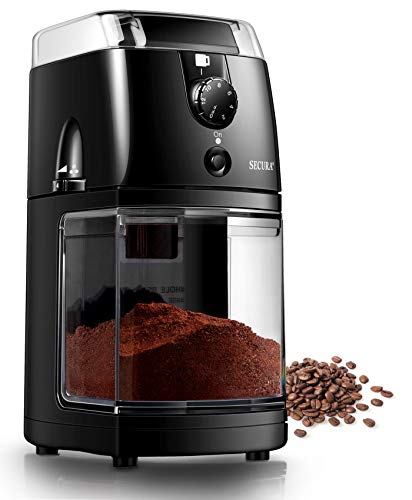
The Secura Electric Burr Coffee Grinder is a burr-style grinder with 17 grind size selections ranging from very fine to coarse, plus a quantity control dial from 2 to 12 cups. For percolators, the coarse settings help avoid over-extraction and grounds passing through the basket. The burr mechanism delivers uniform grounds, which is important for even extraction in a percolator’s circulating brew process. Additional features include an on/off button and automatic shut-off for safety.
Who It Suits: Users seeking a mid-range burr grinder with adjustable cup output and multiple coarse settings suitable for percolator brewing.
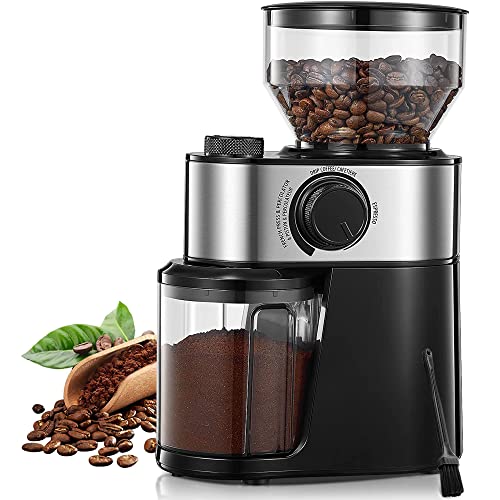
The FOHERE burr grinder offers over 18 precise grind settings and a capacity designed for 2–14 cups. Its metal flat grinding edge aims to produce uniform coffee grounds, which benefits percolator use by reducing fines and promoting consistent extraction. The manufacturer suggests multiple short grinds for finer adjustments, allowing users to fine-tune coarse settings appropriate for percolators.
Who It Suits: Households that need larger batch grinding and a wide range of settings to dial in a coarse grind for percolators while retaining full coffee flavor.
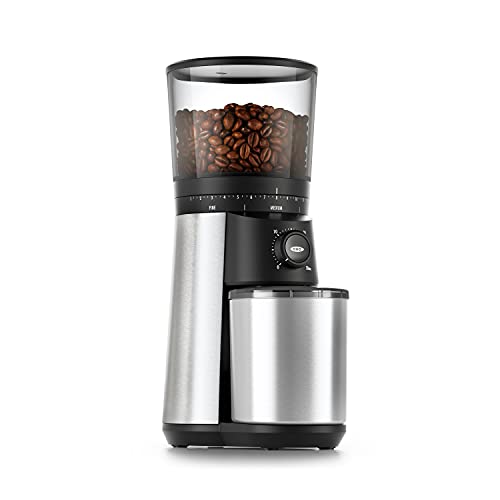
The OXO Brew Conical Burr uses stainless steel conical burrs for precision and uniform grounds. It includes 15 grind settings plus micro-adjustments enabling minor tweaks to reach the desired coarse setting for percolators. A one-touch start that remembers the last setting makes repeatable results straightforward. Conical burrs typically produce fewer fines and heat less, which helps preserve aroma during coarse grinding.
Who It Suits: Coffee drinkers wanting a durable conical burr grinder with micro-adjust control to consistently produce coarse grounds for percolator brewing.
The Hamilton Beach Fresh Grind features a removable stainless steel grinding bowl that is dishwasher-safe, simplifying cleanup between different roast profiles. It can grind enough beans for up to 12 cups and uses stainless steel blades. While blade grinders are less consistent than burrs, the removable chamber and simple operation allow quick grinding and easy transfer into a percolator basket. Blade grinders may produce more fines, so brief pulsing and checking grind size is recommended for percolator use.
Who It Suits: Users prioritizing convenience and cleanup who will monitor and pulse grind to achieve a coarse, percolator-friendly size.
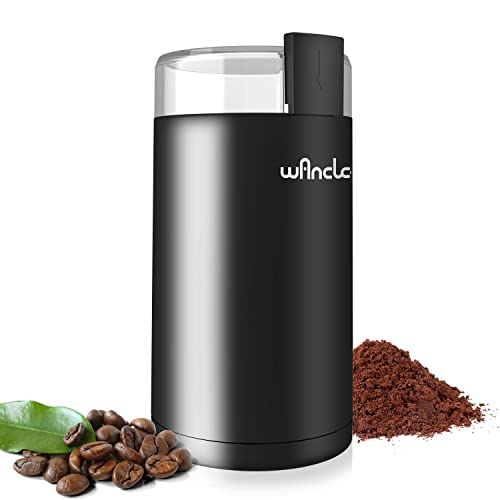
The Wancle Electric Coffee Grinder is a one-touch blade grinder with a pure copper motor and stainless steel blade. The transparent lid enables visual monitoring of grind size, which is useful when aiming for the coarse texture required by percolators. It grinds by pressing and releasing the control button, giving granular control over grind duration. Blade grinders risk heating beans and creating inconsistent particle size, so short pulses and visual checks are recommended.
Who It Suits: Those seeking a compact, one-button grinder with a visible lid for manual control over coarse grind duration for percolator brewing.
Buying Guide: Choosing A Coffee Grinder For A Percolator
Selecting the right grinder for a percolator depends on grind consistency, capacity, and ease of use. Below are key considerations and comparison perspectives to guide a practical choice.
Grind Consistency And Type
Burr Grinders (conical or flat) deliver the most uniform particle size and fewer fines, which reduces over-extraction and clogged percolator baskets. Best overall for percolators.
Blade Grinders are cost-effective and compact but produce more fines and uneven particles. They can work if you pulse and visually control grind time to achieve a coarse texture.
Grind Range And Adjustability
Look for models with explicit coarse settings or a wide range of grind sizes; micro-adjustments help fine-tune the coarse end for percolators.
Quantity control dials (cups) simplify portioning for percolator batch sizes and improve consistency between brews.
Capacity And Batch Size
Match grinder capacity to your typical batch: percolators often brew multiple cups, so 8–14 cup capacity is practical.
Larger hopper capacity reduces the need for multiple grinds but may increase static or retention of grounds in some models.
Heat And Aroma Preservation
High-speed blade grinders can heat beans; use short pulses to avoid flavor loss. Burr grinders operate at lower RPMs and preserve aroma better.
Ease Of Cleaning And Maintenance
Removable bowls or hoppers help with cleaning and switching bean types. Dishwasher-safe parts speed cleanup.
Burrs require occasional brushing; many manufacturers include a cleaning brush or recommend periodic professional cleaning for optimal performance.
Durability And Motor Quality
Look for robust motors and metal burrs for long-term uniform grinding. Consumer-grade copper motors can offer reliable performance in smaller appliances.
Noise, Safety, And Controls
One-touch controls are convenient but provide less precision than timed or dialed options. Automatic shut-off and safety interlocks reduce risks.
Consider noise level if grinding early morning; lower-RPM burr grinders are often quieter than high-speed blade models.
Comparison Perspectives
Performance vs. Budget: Burr grinders cost more but offer the best results for percolators. Blade grinders are budget-friendly with more manual control needed.
Convenience vs. Precision: Single-button blade grinders and removable bowls maximize ease; conical/flat burrs maximize precision and consistency.
Batch Size vs. Storage: Higher-capacity grinders suit large percolators or groups; compact units better for single-serve use or limited counter space.