Choosing the right coffee roaster for commercial use requires balancing capacity, temperature control, ventilation, and build quality. Below is a concise comparison table followed by detailed product sections and a practical buying guide to help you match equipment to your roasting volume and workflow.
| Product | Brand | Key Strength |
|---|---|---|
| CHINEGER 14.5L Coffee Bean Roaster | CHINEGER | Large Capacity, Automatic Rotation |
| GYQSSD Commercial Coffee Roaster Machine (4000g) | GYQSSD | High Capacity, Precise Timing/Temperature |
| Bokknppo 14.5L Coffee Bean Roaster | Bokknppo | Large Capacity, Gas Burner/Drum Style |
| Nut Roaster Machine (4000g) | Generic | Stainless Steel, Adjustable Temp/Timer |
| 500g Coffee Roaster, WQV | WQV | Three Roast Programs, Built-In Smoke Filter |
CHINEGER 14.5L Coffee Bean Roaster Stainless Steel

This unit emphasizes large batch capacity, listing a container volume of 14.5L that translates to roughly 5.5–6.6 lbs per roast. The roaster uses an automatic rotation system driven by a 14W motor with adjustable speed (5–45 rpm) to promote even heat exposure. Internal baffles (V-shaped and T-shaped) aim to improve agitation and uniformity.
Build features include thickened materials and a rectangular support bracket for stability. The ergonomic insulated handle assists material transfer. These attributes align with small commercial operations that need multi-pound batches and consistent agitation during roast cycles.
GYQSSD Commercial Coffee Roaster Machine 4000g

Designed for larger batches, this model offers 2000g/4000g capacity options, suiting operations that need to roast multiple kilograms per cycle. The roaster uses a stainless steel heating tube for efficient and rapid heating and claims easy cleaning and durability.
Control features include a timing design from 0–999 minutes and temperature adjustment up to 350°C, enabling broad roast profiles and extended process control for different beans and roast levels. The product positions itself as a commercial-grade unit with scalable batch sizes.
Bokknppo Coffee Bean Roaster 14.5L/3.83gal
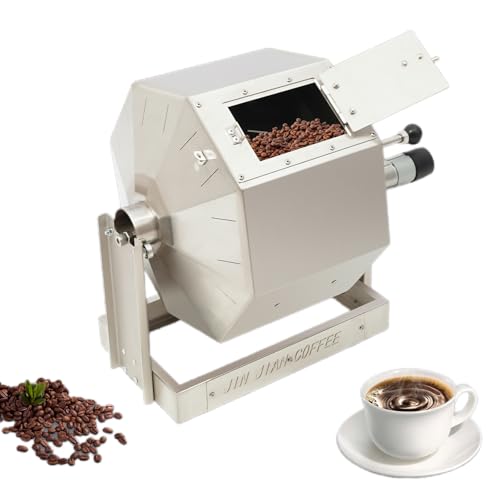
This drum-style unit advertises a 3.83 gallon capacity and estimates batch yields in the 7.7–8.8 lb range per cycle, positioning it for small commercial cafes and higher-volume needs. It combines a motor-driven automatic rotation with stainless steel construction for durability and easy cleaning.
Highlights include an ergonomic design, a stable rectangular base, and consistent rotation speed for even heating. The description suggests suitability for businesses requiring larger batch throughput with mechanical agitation to reduce manual handling.
Nut Roaster Machine Electric Coffee Roaster 4000g

This stainless steel roaster targets both nuts and coffee beans and highlights high insulation and convection heating. It lists adjustable temperature control from 0–350° and a 0–99 minute timer, enabling manual bake/roast cycles for different products.
Ventilation holes help discharge smoke, and the thermostatic control intends to provide even results. The unit is presented as a versatile machine for businesses that need multiuse roasting capability with manual temperature/timer settings for process flexibility.
500g Coffee Roaster Automatic Machine, WQV

The WQV unit is a 500g-capacity roaster recommended for 350–400g optimal batches. It offers three roast programs—automatic, assistant, and manual—as well as nine roasting profiles covering light, medium, dark, and specific processing styles.
Included are a built-in smoke filter, chaff collector, and a bean cooler. While capacity is below most commercial thresholds, its profile-based automation and ventilation features may suit specialty cafes that roast smaller specialty batches or need a compact sample roaster for cupping and recipe development.
Buying Guide: Key Considerations For Commercial Coffee Roasters
Choosing a commercial roaster depends on expected throughput, desired roast control, space, and ventilation. The following considerations will help align equipment capabilities with business needs.
Capacity And Throughput
- Batch Size: Estimate daily roasted volume. Small cafes may manage with 0.5–2 kg batches; roasteries typically need 5–10+ lb batches.
- Cycle Time: Consider roast cycle length and cooling time to determine effective hourly throughput.
Heating Method And Control
- Heat Source: Electric convection, direct flame, or gas-fired drums affect flavor development and energy needs.
- Control Precision: Digital temperature/timing and adjustable RPMs enable repeatable profiles and consistency.
Roast Uniformity And Agitation
- Drum Rotation/Baffles: Even agitation reduces scorching and promotes uniform color development.
- Airflow: Convection vs conduction balance impacts the clarity of flavor and roast speed.
Ventilation And Smoke Management
- Built-In Filters: Useful for light roasts and urban locations where indoor smoke control is necessary.
- Exhaust Options: For medium/dark roasts, dedicated venting to outdoors is often required by code.
Material, Durability, And Maintenance
- Stainless Steel Construction: Simplifies cleaning and resists corrosion.
- Access For Cleaning: Chaff collectors and removable parts reduce downtime and fire risk.
Process Flexibility And Automation
- Preset Profiles: Helpful for replicating roast curves across shifts or batches.
- Manual Override: Valuable for R&D, trialing new beans, or executing custom roast curves.
Space, Noise, And Energy Considerations
- Footprint: Ensure the roaster fits the available space and allows for safe exhaust routing.
- Noise Level: Motors and fans can be significant in customer-facing environments.
- Power Requirements: Verify voltage and amperage needs before purchase and installation.
Compliance, Safety, And Local Codes
- Fire Safety: Regular cleaning of chaff collectors and proper ventilation reduce fire risk.
- Local Regulations: Check codes for indoor roasting, emissions, and commercial appliance installation.
Comparison Perspectives
- Small Cafe Use: Prioritize machines with 0.5–3 kg capacity, integrated smoke filtration, and easy operation.
- Micro-Roaster/Roastery: Favor 3–10+ lb machines with precise temperature control, removable cooling trays, and robust ventilation.
- Multiuse Or Catering: Consider versatile roasters with adjustable temperature ranges and timers that can handle nuts or alternative crops.
Use the above criteria to match roaster specifications—capacity, control, ventilation, and durability—to your commercial volume and operational requirements.