Choosing a commercial pour over coffee maker requires balancing capacity, durability, temperature control and ease of service. The table below summarizes five top commercial pour-over style brewers suited for offices, cafes and high-volume venues.
| Product | Key Feature |
|---|---|
| SYBO 12-Cup Commercial Drip Coffee Maker (2 Carafes) | ETL/CE Certified, Dual Warmers |
| SYBO 12-Cup Commercial Coffee Maker (3 Warmers) | Three Warmers, Drip-Free Carafes |
| crosson 12 Cup Commercial Drip Coffee Brewer | 304 Stainless Funnel, Fast 7–8 Min Brew |
| YUANHAO 12-Cup Pourover Commercial Coffee Maker | Smart-Touch Temp Control, 201–205°F |
| BUNN VPS 12-Cup Pourover Commercial Brewer | Industry-Standard Commercial Brand |
SYBO 12-Cup Commercial Drip Coffee Maker
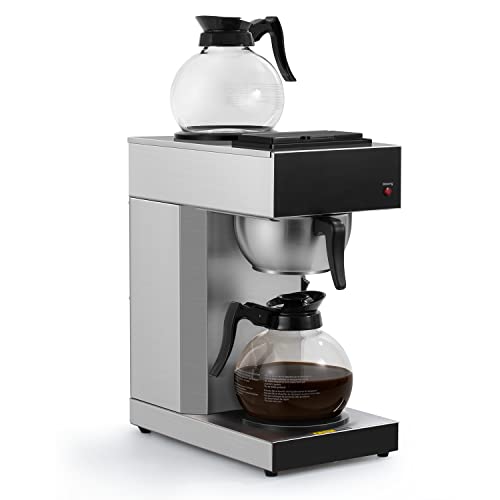
This SYBO model is a commercial-grade drip brewer designed for continuous service. It is ETL, CE, ROHS and Intertek certified, meeting multiple safety standards useful for North American and EU installations. The unit brews up to 12 cups in under 10 minutes, supporting busy shifts. Dual warming plates help maintain serving temperature for two decanters at once, enabling uninterrupted coffee service during refill cycles. Controls are straightforward with indicator lights for operational status. The certified safety credentials and dual-warm plate layout make this model suitable for small to medium commercial environments requiring code-compliant equipment.
SYBO 12-Cup Commercial Coffee Maker With 3 Warmers

This SYBO variant expands service flexibility with three warming stations and three glass decanters. Operation is plug-and-brew with no plumbing or special wiring required, making it suitable for break rooms and pop-up service areas. The brewer claims a full 12-cup pot in under 10 minutes and uses drip-free carafes featuring a lid/spout design that returns drips to the pot. The combination of multiple warmers and simplified controls targets environments where simultaneous hot pots and quick turnover matter.
crosson 12 Cup Commercial Drip Coffee Brewer

The crosson brewer emphasizes extraction and speed. It uses a 304 stainless steel funnel and a water distribution design intended to keep brew water between 195°F and 205°F while evenly raining over grounds. Claimed brew time is 7–8 minutes for a 12-cup pot, faster than many commercial competitors. Two glass decanters provide 12-cup capacity apiece for continuous service. The housing is described as easy-clean and fingerprint-resistant, which can reduce labor for daily maintenance.
YUANHAO 12-Cup Pourover Commercial Coffee Maker

YUANHAO targets temperature consistency and compact footprint. The brewer features smart-touch temperature control with a stated brewing range of 201–205°F and dual warming plates to maintain serving heat. The unit is marketed with high throughput capability, capable of continuous cycles for high-volume settings, and a 12″ depth designed for space-constrained counters. This combination suits locations that need tight temperature control and a small footprint without sacrificing batch capacity.
BUNN VPS 12-Cup Pourover Commercial Coffee Brewer

BUNN is a longstanding commercial coffee equipment brand. The VPS 12-Cup pourover brewer is a recognized option for light-to-moderate commercial duty. Installation and initial operation reference the user manual, which is typical for equipment intended for professional use. BUNN machines often emphasize simplicity of service and replacement parts availability, which can be important for minimizing downtime in a commercial setting.
Buying Guide: Key Considerations For Commercial Pour Over Brewers
Use the following considerations to compare models and match equipment to your operational needs.
- Capacity And Throughput — Match pot size and brew cycle time to expected service peaks. Look at cups per cycle and how many cycles per hour the machine can sustain.
- Warming Stations & Thermal Management — Multiple warming plates support continuous service. Check whether warmers maintain serving temperature without overcooking coffee.
- Temperature Control & Extraction — Aim for brewers that maintain 195–205°F during extraction for consistent flavor. Precision controls or smart-touch interfaces help reduce variability.
- Build Materials & Durability — Stainless steel funnels and housings endure heavy use. Glass decanters are common; consider replaceability and availability of spare parts.
- Certifications & Compliance — For commercial installation, ETL/CE/Intertek certifications indicate adherence to electrical and safety standards in many jurisdictions.
- Serviceability & Parts — Brand reputation for parts and manuals reduces downtime. Consider how easy it is to access filters, heating elements and electrical components.
- Footprint & Installation — Counter depth, power requirements and any plumbing needs should match your available space and electrical supply.
- User Interface & Training — Simple on/off controls reduce operator error in high-turnover venues; smart-touch panels can offer more precise control when staff are trained.
- Flow & Drip Management — Drip-free carafes and spouts that return drips to the pot minimize mess and reduce cleanup time.
- Energy Use & Warm Plate Efficiency — Continuous warming consumes energy. Compare warm plate designs and whether a model supports timed heating or automatic shut-off.
- Flavor Priorities — If extraction quality is a priority, favor models that describe even water distribution, stainless steel funnels and consistent temp range over purely speed-focused units.
Comparative perspective: higher-end models tend to emphasize certifications and temperature control, while faster or lower-cost units focus on throughput and multiple warmers. Choose certified, serviceable equipment for fixed installations; prioritize compact, fast-brew models for pop-up or constrained locations.