Discover versatile cooktops that combine gas and induction or offer advanced induction with precise control. This guide highlights five top choices, focusing on hybrid models and dedicated induction units to help you pick the right option for reliability, efficiency, and cooking flexibility.
| Product | Brand | Type | Key Benefit |
|---|---|---|---|
| 30 Inch Gas Cooktop Mix Induction Cooktop Combo | Weceleh | Hybrid (Gas + Induction) | Bridge mode for large cooking surfaces and total 12000 BTU gas + 2600W induction boost |
| Nuwave Double Cooktop Induction Countertop Burner | Nuwave | Induction | Two independent zones with precise temp control and pre-programmed settings |
| Duxtop Portable Induction Cooktop Burner | duxtop | Induction | Compact, portable, 1800W with digital LCD sensor and safety lock |
| Empava 24” Electric Stove Induction Cooktop | Empava | Induction | Smooth surface, 4 burners, hot surface indicator and pan size sensor |
| TI-1+1B 25-Inch Built-In Dual Burner Cooktop | True Induction | Hybrid (One Induction + One Gas) | Compact dual-burner setup with 1750W induction power |
Note: The products listed here vary in features such as bridge mode, dual fuel options, temperature control, and portability. Each selection is evaluated for safe operation, energy efficiency, and practical kitchen integration.
Weceleh 30 Inch Gas & Induction Hybrid Cooktop

This hybrid cooktop combines two gas burners with three induction zones, totaling 12000 BTU for gas and up to 2600W on induction. Bridge mode enables cooking across a large pan with a single continuous surface, ideal for searing steaks or grilling salmon on a wide tray. It includes a 9-level power range, a slide control, a 99-minute timer, and a pause feature for flexible workflow. Build dimensions are 30″ x 20″ x 4.3″ with a recommended cutout of 28.8″ x 19″.
Nuwave Double Cooktop Induction Countertop Burner

Designed as a portable induction setup, this dual-zone unit delivers independent controls for each side, enabling simultaneous cooking with precise temperatures from 100°F to 575°F. It emphasizes fast heating and high efficiency typical of induction technology, with safety features and preset modes that support a variety of dishes. The unit is compact, making it suitable for small kitchens or travel use.
Duxtop Portable Induction Cooktop Burner
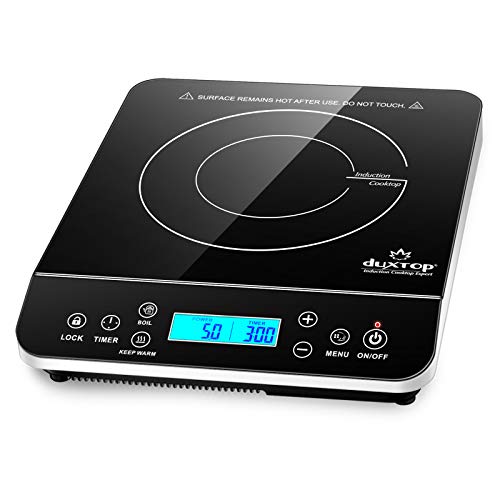
Duxtop offers a compact induction burner designed for standard 110/120V outlets. It provides a wide range of 20 power levels (100–1800W) and 20 temperature levels (100°F–460°F) for precise cooking. A digital LCD panel includes a child safety lock, keep-warm option, and a timer, making it a practical addition for dorms, offices, or limited counter spaces.
Empava 24” Induction Cooktop

Empava’s 24” induction cooktop features a smooth vitro-ceramic glass surface and four power-boost burners designed for efficient, even heating. It includes a hot surface indicator, pan size sensor, and a child lock for safety. The unit is compatible with most induction-ready cookware and is designed for easy cleaning and maintenance in a standard kitchen setup.
TI-1+1B 25-Inch Built-In Dual Burner Cooktop

True Induction’s TI-1+1B combines one induction burner with one gas burner in a compact 25-inch built-in unit. The induction side delivers precise 1750W for rapid control, while the gas burner provides traditional flame-cooking options. This dual-burner design makes it suitable for kitchens with space constraints, offering flexibility for varied recipes and backup cooking options.
Buying Guide: Key Considerations For Gas And Induction Cooktops
- Fuel type and flexibility: Hybrid models offer both gas and induction, reducing downtime during power outages or gas supply issues. Decide whether you want a full induction setup or a mixed-fuel option for versatility.
- Power and heating performance: Look at BTU ratings for gas sections and wattage for induction zones. Higher numbers typically translate to faster heating and more even cooking.
- Control interfaces: Slide controls, touch controls, and timer features affect usability. Consider the learning curve and how you prefer adjusting heat while cooking.
- Safety features: Child lock, auto shut-off, hot surface indicators, and pan size sensors enhance safety, especially in households with children or open-plan kitchens.
- Size and installation: Measure cutouts and overall dimensions to ensure a proper fit. Built-in units require precise cabinet planning, while portable models offer flexibility but less counter space.
- Maintenance and materials: Ceramic glass surfaces are easy to clean but can scratch with abrasive cookware. Check for resistant surfaces and ease of cleaning when selecting.
- Energy efficiency: Induction typically reduces energy loss and keeps surroundings cooler. For frequent cooking, induction-focused setups can save energy over time.
- Cookware compatibility: Induction requires magnetic cookware. Verify compatibility with pots and pans you already own or plan to purchase.
- Budget and reliability: Hybrid models may carry higher upfront costs but offer future-proof flexibility. Consider warranty coverage and availability of replacement parts.
- Installation considerations: Built-in cooktops may require professional installation, proper ventilation, and electrical/Gas connections. Portable units are easier for temporary setups.